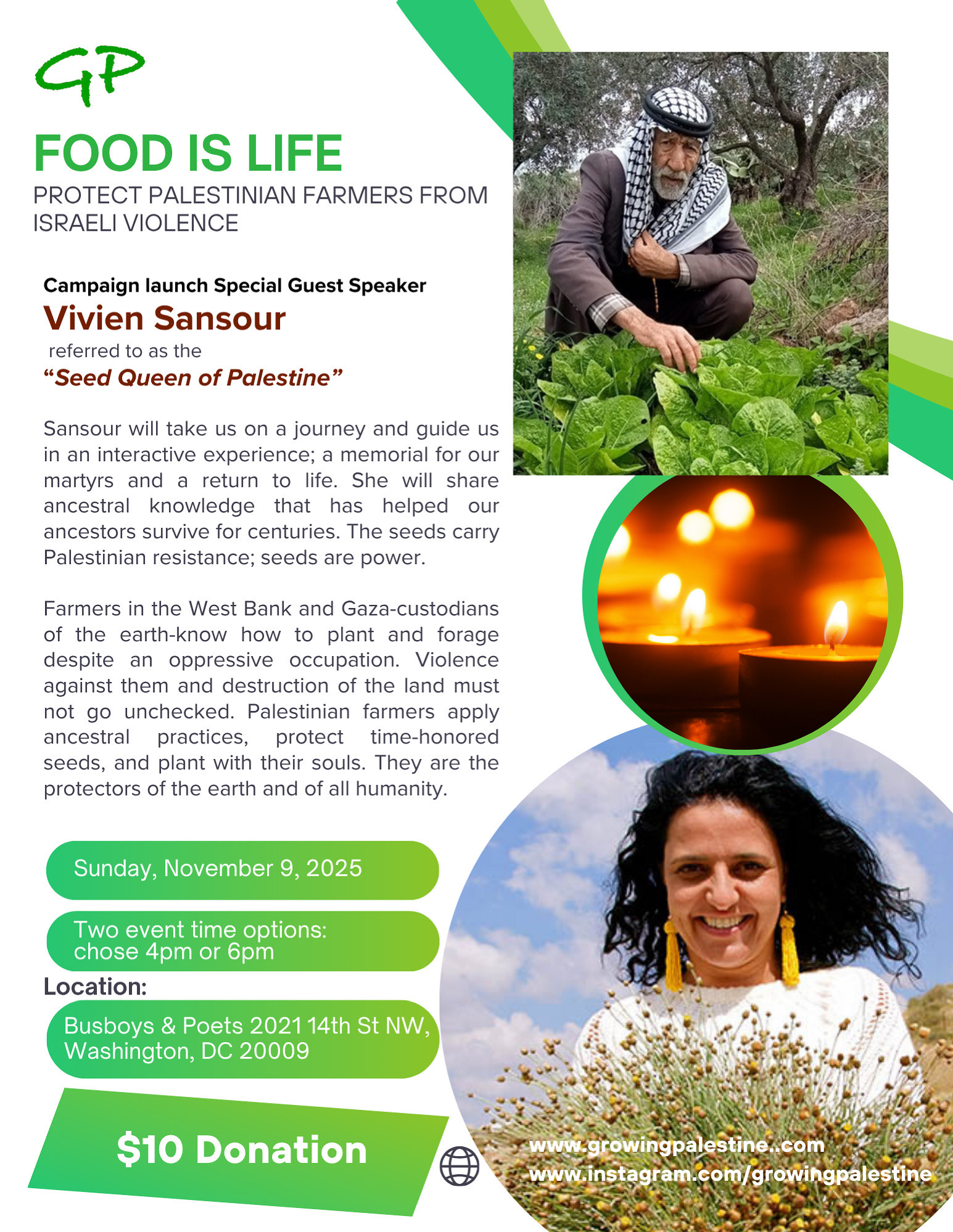
The growing threat to Palestinian agriculture is the focus of Growing Palestine’s campaign “Food Is Life: Protect Palestinian Farmers from Israeli Violence,” launched on November 9 at Busboys and Poets in Washington, DC. We are very grateful to venue owner Andy Shallal, a social justice minded entrepreneur and community activist, for making this space available to us and for his and his wife Marjan’s ongoing support over the years.
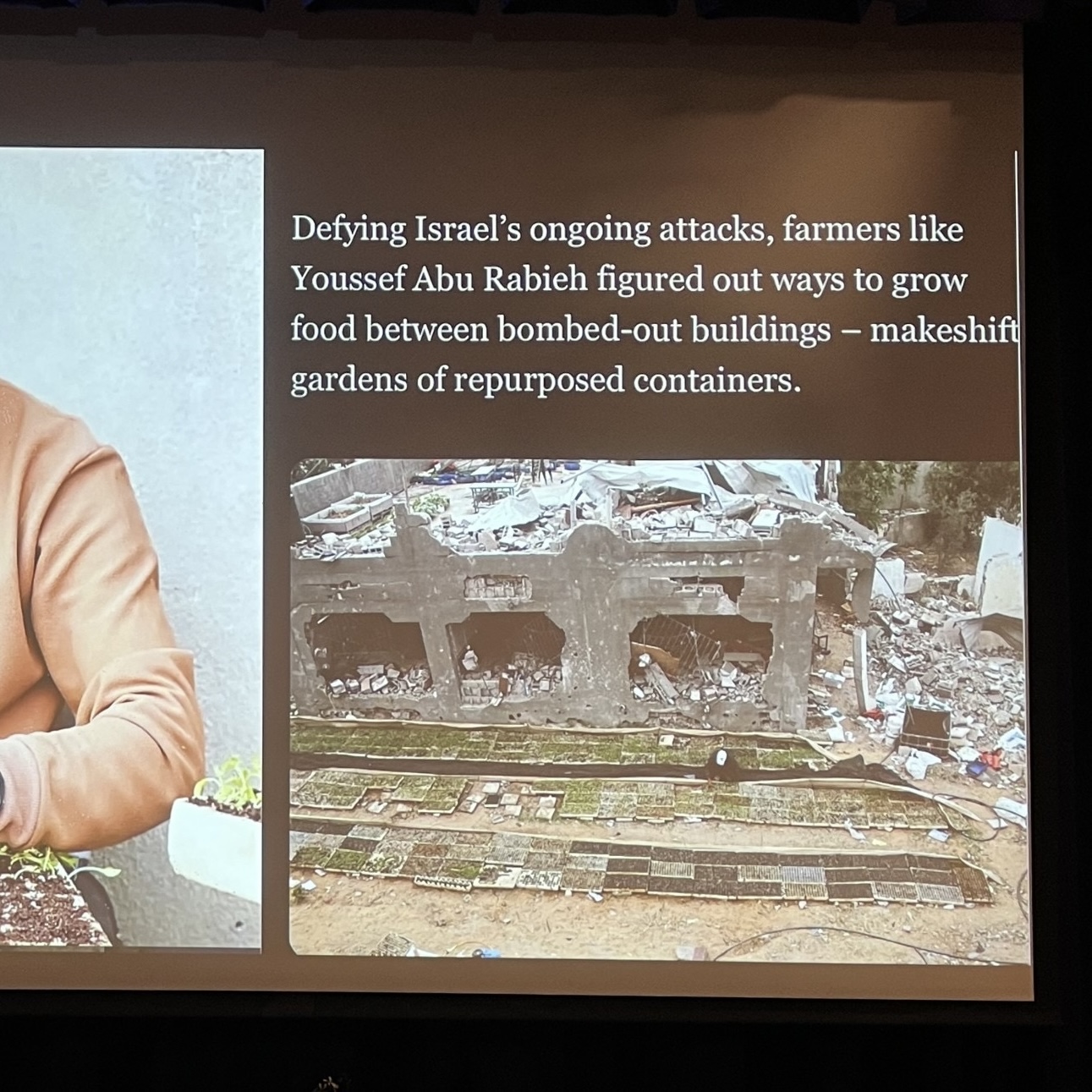
Guest speakers Vivien Sansour and Laila El-Haddad are prominent protectors of Palestine’s agrarian culture. Through slideshow presentations and stories, they described how Palestinians are working to protect food systems from erasure. Vivien Sansour is widely known as the “queen of Palestinian heirloom seeds” because of her single-minded focus on preserving indigenous Palestinian seeds, which have adapted to the dry environment over thousands of years and provide the nutrients needed by the people of that environment. There is a story behind every seed, she maintains, and her effort to learn their stories and preserve them for the people for whom they represent a birthright evolved into the Palestinian Heirloom Seed Library.
The search for seeds connected her to other farmers and enabled her to locate produce that was on the verge of extinction, such as white cucumbers and Abu Samra wheat, and to ensure their preservation. This is how Sansour frames the importance of indigenous seeds: “Our ancient seeds help us to recover ourselves, to remind us of who we are, and to guide us toward a future of abundance, even amidst a present marked by such profound absence.” To ensure the continuation of threatened varieties, seed communities in California, Oregon, and New York are expressing solidarity with Palestinian farmers by planting and collecting the Palestinian seeds. In Maryland, El-Haddad is growing hot peppers with seeds from Gaza. And everywhere these seeds travel, they tell a story. The seed project gave birth to “The Apple Path,” the planting of various types of apple trees across farms and gardens in the West Bank. The project has set a goal of planting 2,000 apple trees next year.
Israel’s obsession with controlling the food intake of Palestinians in Gaza can be dated at least to 2008, when Israel’s minister of defense determined the number of calories required for Palestinians to live but not thrive. El-Haddad (coauthor of the acclaimed Gaza Kitchen cookbook) presented a map that showed the extent of the destruction of agricultural land in each Gaza district. When one considers the amount of land rendered unusable by munitions and contamination, with an additional 40 percent that now falls behind the Israeli-designated “yellow line” and is off limits to residents, today no more than 1-4 percent of Gaza land, located in the Deir al-Balah area, is usable for agriculture. El-Haddad related stories told to her by people living through the genocide who planted on any tiny plot of soil they could find. Some foraged for greens and filmed themselves lightheartedly praising the health benefits of a steady diet of dandelions.
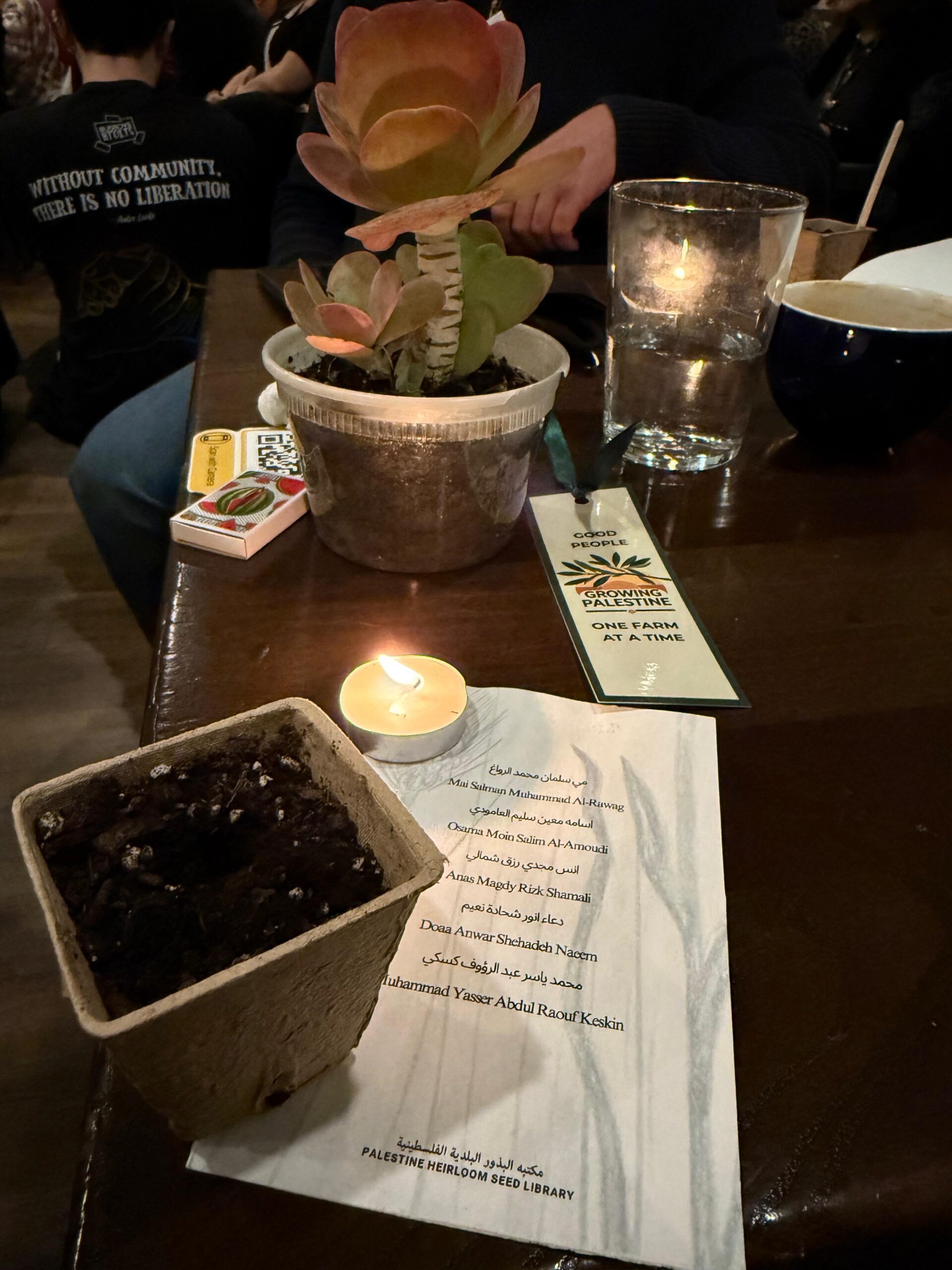
The stories told by Sansour and El-Haddad invariably included a host of guides who educated them about Palestinian foodways. Just about all of them died violent deaths, even the young Hanan, an expert forager who looked to be no more than 11 or 12, shot dead on her way to school one day. Attendees were given cards on which the names of the murdered food protectors were printed, and Sansour encouraged them to light candles and plant seeds (distributed during the event) in their honor. It was a somber reminder of the price paid by Palestinians as stewards of land that others want to control and exploit.
The program ended with poetry and song. Board member and Alexandria, VA poet laureate emerita Zeina Azzam read two poems with food as the theme; we include one of them at the end of this newsletter. We were thrilled to feature Yasmine Foty, a 16-year-old with an enchanting voice, who gave a beautiful rendition of “Ya Taleen ‘al-Jabal.”
Outside the program hall, we had a table with some of the products we received from the farms in the West Bank. The table received a lot of traffic, including from restaurant patrons who were not attending the event. We thank the volunteers who helped us handle
inquiries and accept donations.
We created a short video clip of scenes from the event that provide a flavor of the evening.
*A slightly shorter version of this article was published on the Washington Report for
Middle East Affairs website on November 21, 2025.